High Assurance Agent Engineering
Software engineering has changed forever. As a discipline it can be traced to the start of modern programming languages — when managing and maintaining a software project became of paramount importance. Very soon after the “Hello world” program came into existence in 1972–73, the attention of software engineering turned to “programming in the large” around 1975. But are we writing code any more? Most of us would say the answer is no, but would nevertheless argue for the validation of AI generated code. But what if we are really at the cusp of an industrial revolution — something of the sort of an event which occurs once in 80–100 years. What if the process of coding itself will proceed without us having to work with the code? Recently the head of Claude Code said in X “I’m not prompting my agents anymore, I’m building graphs and loops so they can build the agents for me.” Even if your goal is to write, build and deploy software — you will not be doing software engineering any more — you will be looking at agent engineering!! Thus, even for software engineering, instead of managing software, you will be managing a bunch of agents!
This brings us to the question — is agent engineering only for software engineering? We feel agent engineering is fundamentally different from software engineering — it is the core of the next industrial revolution. Across different sectors of the economy — we are witnessing increased agentification. Any organization with a significant business process or workflow can obtain potential productivity gains by automating parts of that workflow. As a simple example, a bank can automate part of its operational workflow by automating the loan approval task via a curated AI agent. However, such agentification of organizational workflows is currently ad hoc. If loan approval is done by an agent, it can introduce security, compliance, or functionality-breaking risks into the rest of the bank’s processes. Currently, such risks of agentification are not being actively studied or understood; instead, specific components of an organization’s workflow are being agentified in isolation.
With the recent interview from the head of Claude Code, we are perhaps seeing another significant shift in agentification in organisations. It captures the agents organising themselves in groups and hierarchies — as he said “the agents are talking to other agents”. But with self organisation of agents — come increasing risks. Many of us know about the security incident involving OpenAI and Hugging Face — where the agents communicated via expected channels and unexpected ones — creating an out-of-the-box security incident!
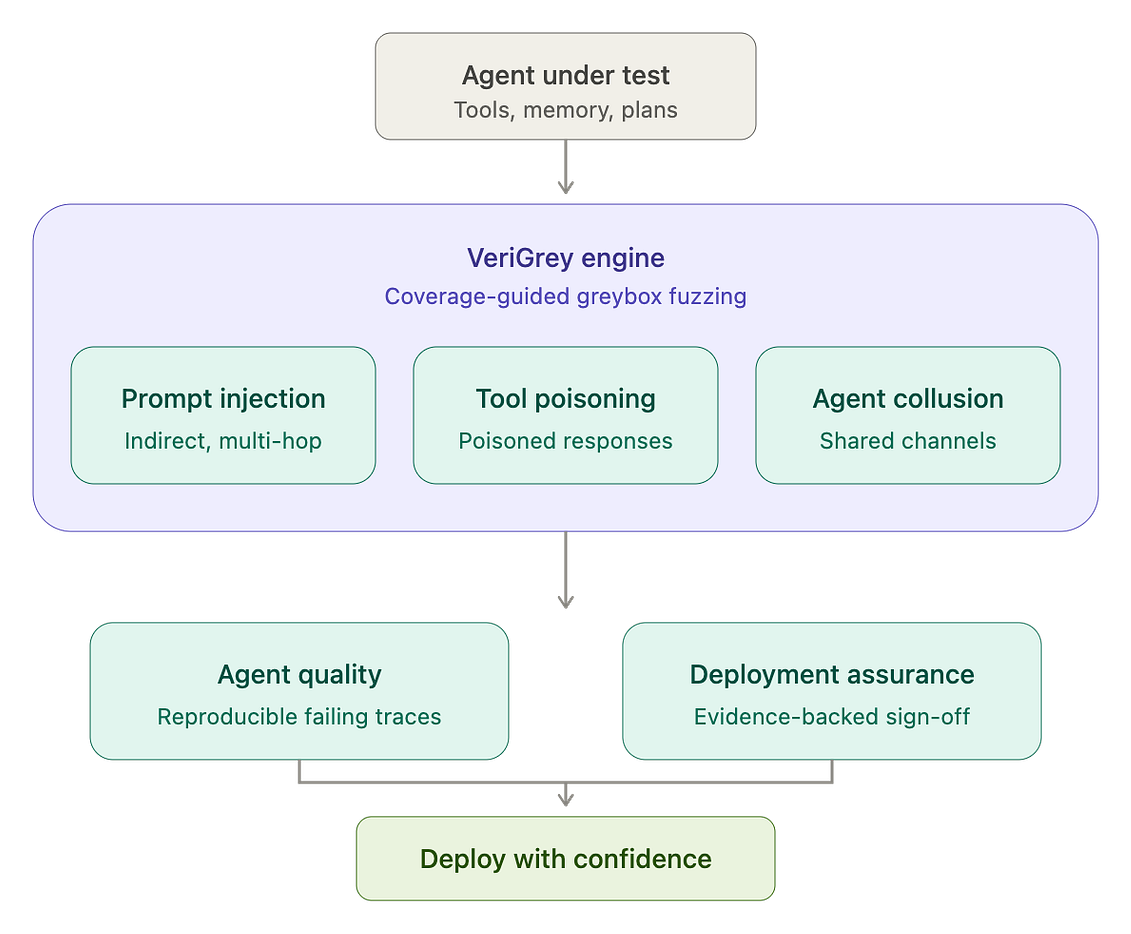
Verigrey’s proposition: As we deploy not only groups of agents, but rather hordes of self organising agent colonies — the risk of such agent collusion, or unexpected behaviors compounds further and further! This is where Verigrey comes in, it teases the grey behaviors in agents both pre-deployment and at run-time. Our adaptive approach does not require enterprises to share access to their agents and yet provides deep levels of assurance. Increased agentification of organisational workflow requires increased assurance against grey and emerging behaviors!!